Before you begin
Confirm your arrival time and tell staff why you’re coming in. They will fit the headset and check calibration.

What happens at your visit, from fitting the headset to reviewing the recording.
Use this guide to prepare, understand the five tasks and explore the measurements.
What to expect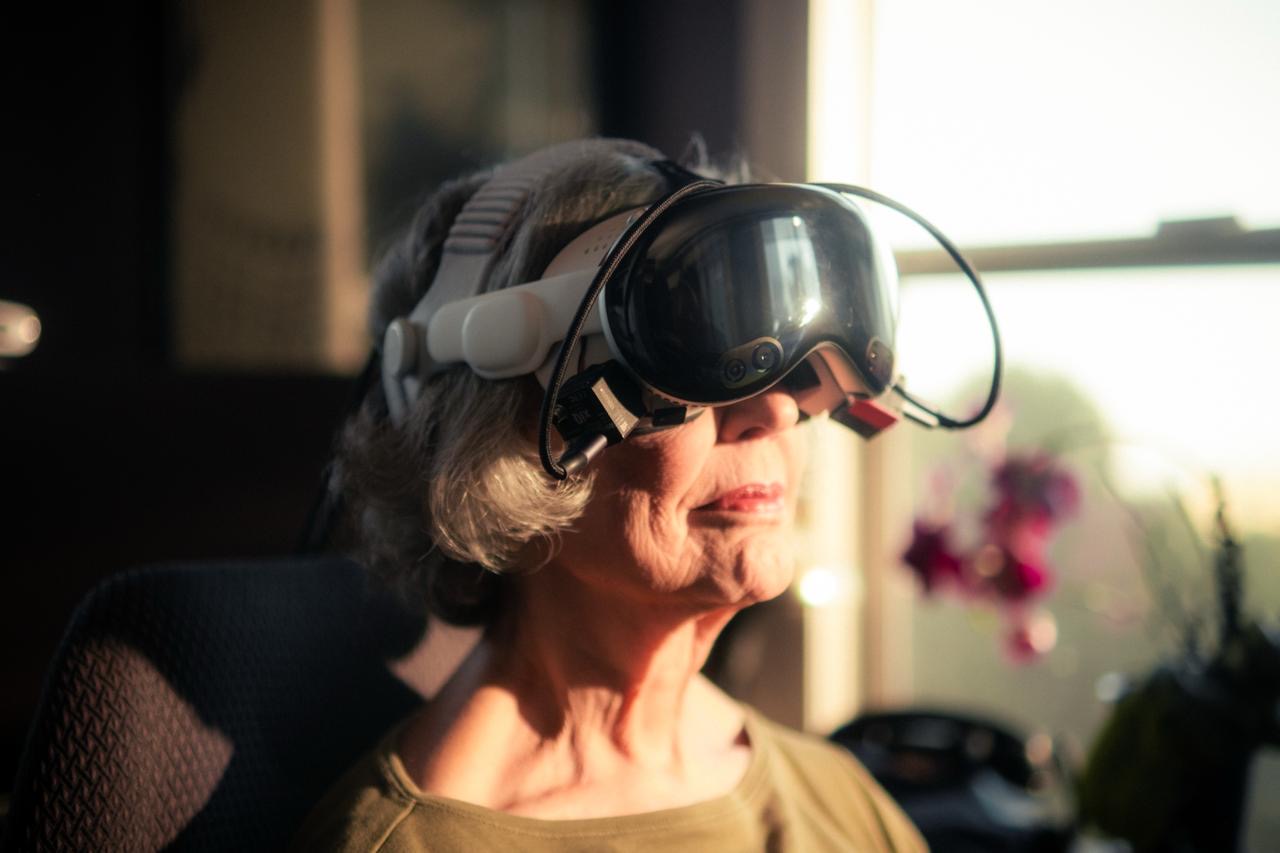
Confirm your arrival time and tell staff why you’re coming in. They will fit the headset and check calibration.
Staff initiate each task. The headset presents visual prompts while separate infrared cameras record your eye movements.
Staff check the recording and may repeat a task if part of it is unclear.
Each task asks you to respond to a dot in a different way. Ask staff to repeat an instruction if you are unsure what to do.

Keep looking at a still dot.
Look at the new dot when it appears.
Look in the opposite direction of the dot.
Look toward the dot as the centre dot changes.
Track a dot moving smoothly across the screen.
Your clinic can answer questions about your appointment and the information you receive.
Yes. You can rest between tasks or stop at any point. Tell staff if you feel tired or if the headset feels uncomfortable.
Tell staff about your glasses, contact lenses and any eye conditions before you begin. They will check the setup with you.
Ask your clinic how long to allow for the full visit, including setup and breaks.
Your clinician and the assessment team. Any research use follows your consent. Ask staff for a copy of the consent information.
Ask your clinic what clinician-reviewed feedback is available and when you’ll receive it. The assessment does not provide a diagnostic or biological-age score.
14 research measures across four categories of eye movement.
Choose a feature to open its definition below.
Open a measurement for its definition and units.
Following the instruction to look away from a dot: the direction of the response, its timing, and where the eyes land.
Eligible responses / %
How often the first movement goes toward the dot when the instruction was to look away. The denominator is usable responses, not every dot shown.
Direction errors / %
Of the initial direction errors, how many are followed by a correction. This describes what happens after a slip; it is not the overall accuracy rate.
Correct look-away trials / ms
The middle response time, from the new dot appearing to the start of a correct eye jump. Only correctly performed trials enter this measure.
Response-time spread / ms
How much correct look-away response times vary from trial to trial. A typical response time and its consistency describe different parts of the recording.
Movement / required distance
How far the first jump travels, divided by the required distance. A ratio of 1.0 means the requested distance; it is not a health score or clinical target.
Position / degrees or ratio
Where the eyes finish after any correction, compared with the intended mirror location. The chosen definition reports position error or a final distance ratio.
No qualifying response / %
How often an eligible trial has no qualifying eye jump within the defined time window. A missing response is not automatically a lapse of attention.
The timing and accuracy of looking toward a dot, providing a comparison with the look-away task.
Look-toward trials / ms
The middle time taken to begin looking toward a new dot. It provides a comparison for the additional demands of the look-away task.
Response-time spread / ms
How much look-toward response time varies across trials. This helps describe consistency in the simpler task, alongside its median response time.
Movement / target distance
The distance travelled by the eye divided by the distance to the target. It describes the size of the movement, separately from how quickly it begins.
Accepted target landings / %
The percentage of counted responses that land within the target acceptance window. The window must be defined before interpreting the result.
The difference in response time between looking away and looking toward, within the same person.
Measure 03 minus 08 / ms
The difference between median correct look-away time and median look-toward time. This compares the two tasks within one person.
How steadily the eyes hold their position, and how the timing of the centre dot affects the next response.
Holding still / degrees squared + count
The area covered by gaze during a hold, described by a contour ellipse, alongside the number of brief intrusive jumps. These describe stability in different ways.
Overlap minus gap latency / ms
The response-time difference when the centre dot remains briefly versus disappearing early. This explores how the timing of releasing fixation changes the response.
The features describe different parts of a response: timing, direction, accuracy and steadiness. The useful question is how these fit together, not whether one value falls outside a range. One unusual value is not a diagnosis.
A percentile shows where a result sits within a reference group of similar age. It is not a percent-correct score or a disease risk. Age-based ranges are not yet available in the current reporting system.
Repeat visits can build a record to discuss with your clinician. Sleep, medication, vision and practice can change a result, so a difference alone does not show that a longevity routine is working.
These are investigational research measures, not a validated measure of biological age.
Opwonya et al. Saccadic Eye Movement in Mild Cognitive Impairment and Alzheimer’s Disease: A Systematic Review and Meta-Analysis. Neuropsychology Review 32, 193–227 (2022).
Read the publicationThis research describes differences between groups; it does not validate Saccade’s panel for individual diagnosis.
Get started for yourself or a loved one.
Take the test today